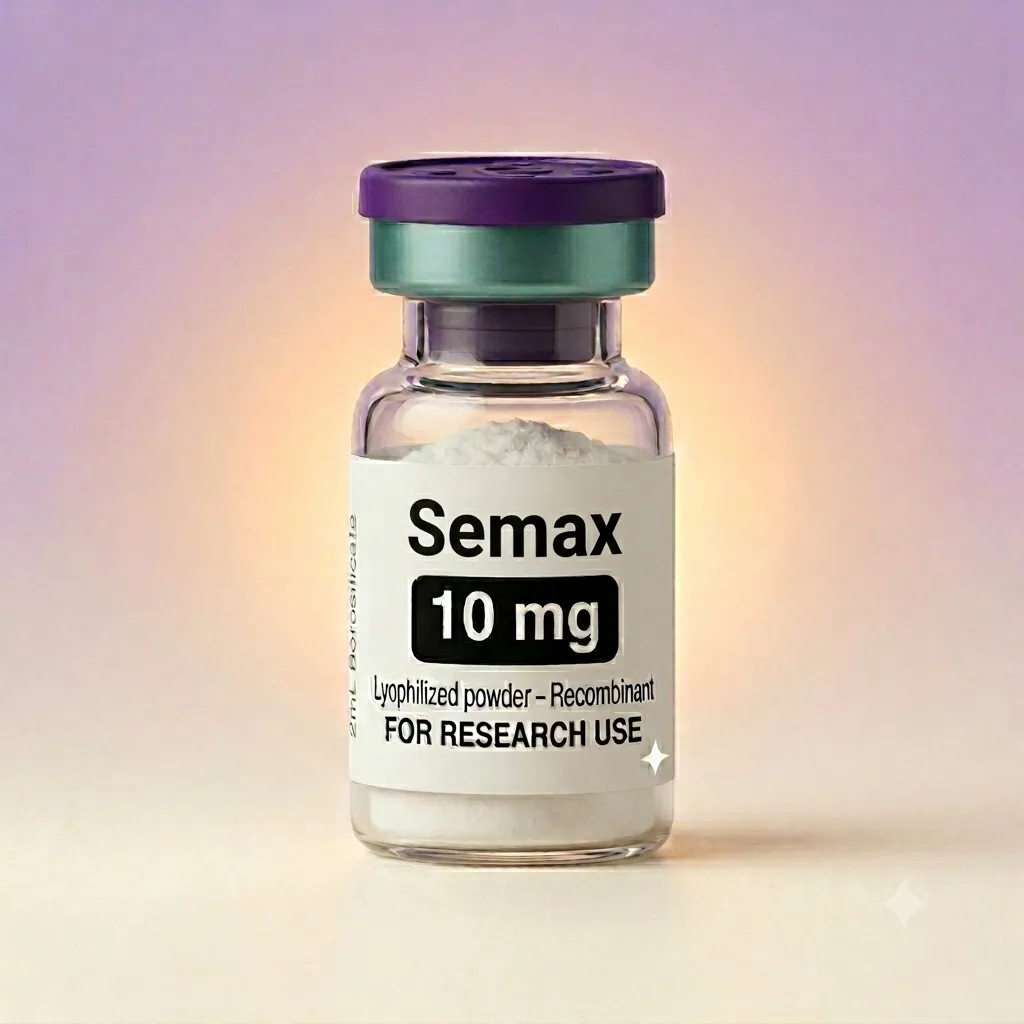
General Description
Semax, synthetically developed, has been widely investigated for its potential mechanism of
action and praised for its apparent biological stability. Researchers suggest it may inhibit
select enzymes that regulate the degradation of enkephalins, naturally released and secreted
neurotransmitters in the brain, which scientists believe may regulate various biological
functions. Enkephalins are believed to be significantly involved in nociception (the sensory
perception of pain) and the stress response. Furthermore, an elevation in enkephalin
concentrations could potentially impact other neurotransmitter systemás due to the intricate
interconnections between the opioid system and neurotransmitters such as dopamine and
serotonin. This interaction may manifest through the modulation or alteration of
neurotransmitter release, receptor activity, or signal transduction pathways, indicating a
sophisticated and multifaceted relationship that remains an area of active research. In
addition to enkephalins, Semax has been evaluated for its potential to inhibit other
peptide-degrading secreted enzymes.
Based on a specific research study,(4)Semax may induce elevated secretion and release of
dopamine, as well as possibly increasing levels of brain-derived neurotrophic factor (BDNF).
Based on another study,(5)it has been speculated that Semax also harbors the potential to
alter gene expressions modulating the immune system. By altering gene expression, immune
cell levels and their mobility may rise. Researchers reported that Semax exhibits potential
for alteration in the encoding of chemokines and immunoglobulins, related to vascular system
functioning.
Chemical Composition
- Molecular Formula: C39H54N10O10S
- Molecular Weight: 854.99 g/mol
- Other Known Titles: ACTH (4-7)PGP, HY-P1146
Semax Peptide and Nootropic Action
An initial study(6) was conducted on the hormone ACTH and its analogues, including Semax, to
determine their nootropic potential in murine models. After peptide exposure in the models,
5-hydroxyindoleacetic acid (5-HIAA) levels were monitored. 5-HIAA levels appeared elevated
by 25% after 2 hours of Semax presence. Levels appeared to increase gradually to a maximum
of 180% within 4 hours after peptide exposure. Researchers noted that the peptide, when
introduced 20 minutes prior to D-amphetamine, appeared to lead to an elevation of 5-HIAA
compared to Semax exposure alone. 5-HIAA is a primary metabolite of serotonin, indicating
that Semax might enhance serotonergic activity. This hypothetical influence on serotonin
metabolism could enhance the functions of serotonin-dependent pathways, which may affect
operations within the central nervous system. This speculative action underscores a possible
modulation of neurotransmitter systemás that play critical roles in mood, cognition, and
general brain function.
Semax Peptide and Neonatal Anxiety Models
The main objective of this study(7) was to expose neonatal murine models to an SSRI and then
to Semax, to evaluate the interaction. Murine models between 1 and 14 days old received an
SSRI, followed by Semax on days 15 to 28. After 28 days, it was observed that following SSRI
exposure, rats exhibited anxiety-like behavior, with an apparently impaired response to
stressors and novel stimuli during the first 14 days. After Semax exposure, these
SSRI-induced actions appeared to be mitigated, with rats even exhibiting improved learning
capabilities and a general reduction in anxiety-driven behaviors. Researchers posited that
Semax might have re-established normal monoamine levels in the brain, which may have been
initially diminished by the SSRI. By affecting these neurotransmitter systemás, Semax might
restore or stabilize neural pathways that were previously disrupted. Such changes could
balance excitatory and inhibitory signals in the brain, creating a state more conducive to
reducing anxiety. For example, by potentially increasing serotonin levels, Semax may improve
mood and decrease anxiety, while optimizing dopamine could enhance motivation and reward
processing. Additionally, norepinephrine adjustments could improve attention and vigilance.
Behavioral assessments conducted in the experiment indicated that these potential Semax
actions appeared temporally stable. The reduction in anxiety-related behaviors was
maintained from adolescence into early adulthood, suggesting that Semax might have a lasting
influence on neuronal circuits. This enduring stability implies that Semax might support the
creation of a protective or corrective action in these circuits that persists beyond
immediate exposure.
Semax Peptide and the Vascular System
In this study,(8) researchers evaluated Semax's potential to protect murine heart models
from vascular damage following experimental myocardial infarction (MI). Murine models were
induced with myocardial infarction, and a cohort of the models was exposed to Semax in an
experimental group for the following 6 days. On day 28, researchers reported that murine
models serving as the control group appeared to have developed cardiac hypertrophy along
with a decrease in blood pressure. Models exposed to Semax exhibited signs indicating
prevention of diastolic pressure growth in the left ventricle, with apparent remodeling of
the left ventricle. Notably, the peptide may have improved both cardiomyocyte hypertrophy
and the imbalance between contractile and mitochondrial apparatus growth.
Semax Peptide and Neonatal Deprivation
Adolescent rats(9) were separated from their mothers for approximately 5 hours per day
during postnatal days 1 to 14. From days 15 to 28, these adolescent rats were exposed to the
peptide Semax. After 28 days, it was found that during maternal deprivation, when Semax was
not present, there was an apparent increase in anxiety and physical and emotional reactivity
in the rats. Following Semax exposure, researchers reported that reactions and anxiety in
the rats appeared restored to control levels.
Semax Peptide and Neuroprotection
This clinical trial(10) was conducted on 100 ischemic stroke models. A cohort representing
30% of the models was exposed to Semax, while the rest were evaluated as a control group.
After the study, researchers reported that following Semax exposure, there appeared to be an
improvement in the rate of restoration of damaged neurological functions. All results were
analyzed using EEG mapping.
Semax Peptide and Nootropic Properties
A small-scale clinical trial(11) was conducted in which Semax was administered to research
models under high-stress conditions, and subsequent brain activity was monitored. At the end
of the study, after a total of 24 hours, researchers reported that, compared to normal
pre-trial thresholds, the models appeared to exhibit greater memory recall and increased
concentration intervals.
References
- T. Kolomin et al., A New Generation of Drugs: Synthetic Peptides based on Natural Regulatory
peptides. Neuroscience & Medicine, 2013, 223-252. Published Online December 2013. http://dx.doi.org/10.4236/nm.2013.44035
- Dornbush RL, Nikolovski O. ACTH 4-10 and short-term memory. Pharmacol Biochem Behav.
1976;5(Suppl 1):69-72. doi: 10.1016/0091-3057(76)90331-2. PMID: 189333. https://pubmed.ncbi.nlm.nih.gov/189333/
- Kost NV, Sokolov OIu, Gabaeva MV, Grivennikov IA, Andreeva LA, Miasoedov NF, Zozulia AA.
Ingibiruiushchee deĭstvie semaksa i selanka na énkefalindegradiruiushchie fermenty syvorotki
krovi cheloveka [Semax and selank inhibit the enkephalin-degrading enzymes from human
serum]]. Bioorg Khim. 2001 May-Jun;27(3):180-3. Russian. doi: 10.1023/a:1011373002885. PMID:
11443939. https://pubmed.ncbi.nlm.nih.gov/11443939/
- Shih-Jen Tsai, Semax, an analogue of adrenocorticotropin (4–10), is a potential agent for
the treatment of attention-deficit hyperactivity disorder and Rett syndrome, Medical
Hypotheses, Volume 68, Issue 5, 2007, Pages 1144-1146. https://doi.org/10.1016/j.mehy.2006.07.017
- Medvedeva, E.V., Dmitrieva, V.G., Povarova, O.V. et al. The peptide semax affects the
expression of genes related to the immune and vascular systemás in rat brain focal ischemia:
genome-wide transcriptional analysis. BMC Genomics 15, 228 (2014). https://doi.org/10.1186/1471-2164-15-228
- Eremin KO, Kudrin VS, Saransaari P, Oja SS, Grivennikov IA, Myasoedov NF, Rayevsky KS.
Semax, an ACTH(4-10) analogue with nootropic properties, activates dopaminergic and
serotoninergic brain systemás in rodents. Neurochem Res. 2005 Dec;30(12):1493-500. doi:
10.1007/s11064-005-8826-8. PMID: 16362768.
- Nataliya Yu. Glazova, Daria M. Manchenko, Maria A. Volodina, Svetlana A. Merchieva, Ludmila
A. Andreeva, Vladimir S. Kudrin, Nikolai F. Myasoedov, Natalia G. Levitskaya, Semax,
synthetic ACTH(4–10) analogue, attenuates behavioural and neurochemical alterations
following early-life fluvoxamine exposure in white rats, Neuropeptides, Volume 86, 2021,
102114, ISSN 0143-4179. https://doi.org/10.1016/j.npep.2020.102114
- Gavrilova SA, Golubeva AV, Lipina TV, Fominykh ES, Shornikova MV, Postnikov AB, Andrejeva
LA, Chentsov IuS, Koshelev VB. [Protective effect of peptide semax (ACTH(4-7)Pro-Gly-Pro) on
the rat heart rate after myocardial infarction]. Ross Fiziol Zh Im I M Sechenova. 2006
Nov;92(11):1305-21. Russian. PMID: 17385423. https://pubmed.ncbi.nlm.nih.gov/17385423/
- Volodina MA, Sebentsova EA, Glazova NY, Levitskaya NG, Andreeva LA, Manchenko DM, Kamensky
AA, Myasoedov NF. Semax attenuates the influence of neonatal maternal deprivation on the
behavior of adolescent white rats. Bull Exp Biol Med. 2012 Mar;152(5):560-3. English,
Russian. doi: 10.1007/s10517-012-1574-2. PMID: 22803132. https://pubmed.ncbi.nlm.nih.gov/22803132/
- Gusev EI, Skvortsova VI, Miasoedov NF, Nezavibat'ko VN, Zhuravleva EIu, Vanichkin AV.
Effektivnost' semaksa v ostrom periode polusharnogo ishemicheskogo insul'ta (klinicheskoe i
élektrofiziologicheskoe issledovanie) [Effectiveness of semax in acute period of hemispheric
ischemic stroke (a clinical and electrophysiological study)]. Zh Nevrol Psikhiatr Im S S
Korsakova. 1997;97(6):26-34. Russian. PMID: 11517472. https://pubmed.ncbi.nlm.nih.gov/11517472/
- Asmarin IP, Nezavibat'ko VN, Miasoedov NF, Kamenskiĭ AA, Grivennikov IA, Ponomareva-Stepnaia
MA, Andreeva LA, Kaplan AIa, Koshelev VB, Riasina TV. Nootropnyĭ analog adrenokortikotropina
4-10-semaks (15-letniĭ opyt razrabotki i izucheniia) [A nootropic adrenocorticotropin analog
4-10-semax (l5 years experience in its design and study)]. Zh Vyssh Nerv Deiat Im I P
Pavlova. 1997 Mar-Apr;47(2):420-30. Russian. PMID: 9173745. https://pubmed.ncbi.nlm.nih.gov/9173745/